Sunday, February 28, 2010

Ampthill Park - Westminster Pond & Bedfordshire Mammals [Updates]

February has come to an end and, after two months, I have managed to see 15 separate mammal species, including the unidentified Pipistrelle. This is the full list:

1) Rabbit (1st January – Kempston Hardwick verges).
2) Chinese Water Deer (1st January – Flying Horse Farm).
3) Grey Squirrel (2nd January – Millbrook Plantation).
4) Muntjac (2nd January – Millbrook Plantation).
5) Red Fox (4th January – Brogborough Lake).
6) Brown Hare (7th January – Ampthill area).
7) Brown Long-eared Bat (13th February).
8) Natterer’s Bat (13th February).
9) Pipistrelle Bat sp (13th February).
10) Barbastelle Bat (13th February).
11) Daubenton’s Bat (13th February).
12) Common Shrew (17th February – Ampthill Park).
13) Pygmy Shrew (18th February – Ampthill Park).
14) Wood Mouse (18th February – Ampthill Park).
15) Stoat (24th February – Ampthill Park).

Many thanks to Trevor Dix who sent a number of photos and updated me this morning regarding the Ampthill Angling Club's transfer of fish from Westminster Pond to Marston Pit. Following my visit yesterday morning, the Club repaired the net and had another go, this time catching even more fish and removing 79 Common & Mirror Carp, and 60lbs of 'silver fish'. They also caught an amazing 10 Catfish, including what appears to me to be the grand-daddy of them all looking at Trevor's photos below. You can see all of the photos and more on the Ampthill Angling Club website here.


Saturday, February 27, 2010

Maulden Heath

After an unsuccessful hunt for Bank Voles at Duck End Nature Reserve, and with the sun shining, I decided to pop over to Maulden Heath for my first visit of the year in the hope of catching up with an early Adder. Steve Cham had spotted one earlier in the week. I was really pleased to find this large male - he doesn't look much at the moment, especially covered in mud but, when he sloughs in a few weeks time, he'll be a very striking black and white individual. Later I met Roy, who had earlier found two more male Adders at the other end of the Heath, but with clouds now filling the skies and a cold wind blowing, they had gone by the time I arrived!

Ampthill Park - Westminster Pond

This morning I joined a bunch of members from the Ampthill Angling Club as they netted an over-stocked Westminster Pond in order to catch and transfer a number of Mirror Carp and Common Carp to Marston Pit, near Lidlington. It was fascinating to watch the operation taking place.

It was difficult to get any decent photos, though I'll try to put some video footage up here sometime soon. Unfortunately, the net snagged and ripped in several places which allowed a number of fish to escape, but there was still a good haul: Roach, Rudd, Tench, Bream, Perch (my favourite fish), Catfish, and several Carp species: Ghost Carp, Mirror Carp, Common Carp and Crucian Carp. 28 Common & Mirror Carp were caught and removed. But the highlight for me were two Wels Catfish, which I've never seen before. There is reputed to be a specimen in the pond that approaches 30lbs. The individual below is smaller - probably 15-20lbs - but it's still a pretty impressive beast!


Ampthill Park Verge

This is an old sign board from The Cellar Bar in Ampthill that I found discarded here some years ago now. I regularly check underneath it because it's yielded quite a few small mammal records over the years.

And this is what lies beneath...a little nest, which I've assumed to be the work of a Bank Vole, and a couple of pretty wide runs, evidence of Brown Rat activity.

...but when I lifted the refuge this morning, I found this Common Shrew scuttling around underneath and wondering where the roof had gone! I still think that the nest has been constructed by a Bank Vole, though, and that this little beastie happened to be visiting when I arrived. It will be interesting to see what occurs under here in the next few weeks.

Wednesday, February 24, 2010

Ampthill Park

In my endeavours to record as many Bedfordshire mammal species as possible this year, I've been really frustrated so far by the lack of Mustelid records, despite the number of hours accumulated in the field. I've spent many an early morning over Stewartby Lake and Marston Vale Country Park over the last few weeks hoping for Otter and American Mink, but to no avail. And my walks over Ampthill Park have so far failed to produce the Stoat sightings that I would have expected.

But I know the Stoats are there so, at dusk this evening, I decided to make my way down to The Rezzy, where I have had most of my sightings over the years, and wait...

....and half an hour later, a Stoat appeared out of the bottom of a Bramble bush just a few metres away from where I was standing, bounded along the path, and then disappeared back into the Bramble, much to the consternation of a local Wren who churred away in alarm!

If only it was that easy with Otters!

I've had some really exciting experiences with Stoats over the years. They really are my favourite animals, alongside Otters. Here's an account of an encounter at The Rezzy from June 2008:

'Nature red in tooth and claw'...so wrote Tennyson. And I had a vivid demonstration of it this afternoon when I took my friend, Ian, for a walk over Ampthill Park. Whilst walking along the footpath around The Rezzy (a small lake), a wren started churring frantically, and a young rabbit ran down the path straight towards us. My immediate reaction was, "stoat!" and, sure enough, a stoat appeared, bouncing down the path in pursuit of the the rabbit. The rabbit turned into a gap in the scrub right by where we were standing, now closely followed by the stoat. Moments later there was a pitiful scream and we saw the stoat holding the back of the rabbit's neck in its death-grip jaws. Suddenly noticing us, the stoat dropped the rabbit and retreated, but returned moments later and dragged it through the large mesh fence and into the long grass.

Fifteen minutes later, and a few hundred metres to the west of The Rezzy, we heard more frantic squeals and looked up to see another stoat chasing after a rabbit. Amazingly, it brought it down less than 5 metres from us. We moved closer and the stoat bounded several metres away, characteristically sitting up on its haunches to size us up. It then moved closer...and then further away, continuing to regard us quizzically, giving us cracking views. After a few minutes we moved further back, allowing the stoat to bound up to the rabbit, grasp it, and carry it away with ease.

Incredible. I've never actually seen a stoat catch a rabbit before, and today I saw 2 kills within the space of a quarter of an hour almost at my feet. What is it that they say about buses....?!

Friday, February 19, 2010

Ampthill Park

I managed to fit in some small mammal trapping this week. One of the 6 Sherman traps I set was in a promising position under some emergent vegetation on the water’s edge at Westminster Pond. The ideal would have been Water Shrew, but I was really pleased to find this Common Shrew in the trap later on in the day. It was on the very small side and so I initially identified it as Pygmy Shrew but, examining this photo, I wondered whether the tail and the colours of the flank might indicate that this was, actually, a Common Shrew. After consulting with Mick McCarrick and Richard Lawrence we decided that this was, indeed, the case. I did catch a Pygmy Shrew close to this location the following morning....so a Water Shrew would be nice in the future (Evidence of them has been found in this area when bait tubes were set here a few years ago by Mick as part of the Mammal Society's Water Shrew Survey).

I also caught this Wood Mouse in the hedgerow just north of the Field Pond - look at the length of that tail! It’s my 14th mammal species of the year so far.


In the copse above Ampthill Tunnel to the north-west of Westminster Pond, there were several clumps of Velvet Shank (Flammulina velutipes) - my 247th species of fungus for the Park. It is edible and particularly popular in Japanese dishes where one of the various names that it is known by is Inotake. Closer to home it is also known as Winter Fungus because of it’s ability to withstand very cold weather, even to the point of being frozen. Indeed, the cold weather stimulates its growth. The dark brown section at the base of the stem really does feel velvety - hence the name!

There are several species similar to Velvet Shank, but it’s easy to confirm this species by observing the spores which are white, rather than yellow. So, last night, I placed one of the larger caps on my British Moths book by Chris Manley, assuming that the black glossy part of the cover would show up any white spores well.

And here’s this morning’s result: Voila – Velvet Shank confirmed!

Monday, February 15, 2010

Saturday: Bat Hibernation Survey

The bat was big and brown with a dark face. Year after year, it used to hang upside down in a cage high up in a corner of the pet shop in Coventry City Centre when I was a young boy. Everyone in Coventry knew about it and, before yesterday, it was the closest I’d ever been to a bat….so to see over 50 in one day, many of them just inches away from my nose, was pretty special!

The occasion was one of the regular Bat hibernation surveys carried out by the Bedfordshire Bat Group. Soon after 9.30am, Bob, Soggy, Jon, Peter & I set off in a northerly direction from Ampthill – our mission: to visit 3 ice-houses in the morning and another prime hibernation site in the afternoon.

We made our way to the first location through a small cottage garden where Snowdrops and Winter Aconites were flowering, and then into the quaint little ice-house itself. There we found 9 hibernating Peacock Butterflies, 4 hibernating Herald Moths…and 1 hibernating Brown Long-eared Bat! Result!

And so, by the time we arrived at our second site, I’d already got the bug or, in this case, the bat! This ice-house dated back to the early 1800s. More recently, it was here that Bedfordshire’s first Barbastelle Bat was recorded in 1994…the species that I was most hoping to catch up with today, so I was quite excited as we made our way into the entrance tunnel. There, in the crumbling brickwork we found another Brown Long-eared Bat and 2 Natterer’s Bats. The main chamber was flooded and we prevaricated over whether it would be worth setting up the ladder in the water. We decided to go for it and our diligence was rewarded when Jon, standing on a rung below the waterline, was able to pick out 3 more Natterer’s Bats huddled together in a gap above the lintel….satisfaction all round!

The last ice-house was situated in the middle of a field. After tending to a dying lamb in the entrance, we descended into the chamber, taking care to avoid the rows of rotting wooden shelves dating back to the years when the ice-house was converted to an apple store. There are no apples nowadays, but a bat brick set in the ceiling contained yet another Brown Long-eared Bat…which all goes to show that there’s a bit of to-ing and fro-ing going on even in the cold weather we’ve been experiencing, because the same bat brick yielded not a Brown Long-eared Bat, but 2 Natterer’s Bats during the January survey!

At the last site we were joined by Katharine and, after enjoying our sandwiches and a hot drink, we made our way to the location, which has produced good numbers of hibernating bats year on year. It was big and dark, and not the sort of place you’d want to be on your own, especially if you’ve got an over-active imagination, but it made for a fascinating period of time searching the various nooks and crannies! By the time we had finished, we had recorded 49 Bats. Natterer’s Bats were the most commonly encountered species, with 31 individuals recorded, their lighter pelage, longer outward-pointing ears, and extended snouts with little pink noses contrasting with the 9 smaller and duller Daubenton’s Bats that we came across. There was also another Brown Long-eared Bat tucked away behind a plank in the ceiling high above us, and a Pipistrelle species in a regular crevice between two bricks.
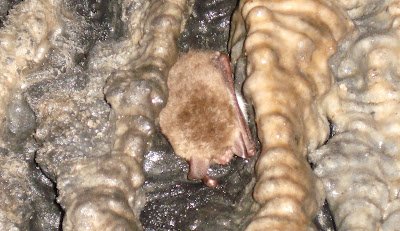
Here is one of the Natterer's Bats which was hibernating in a surprisingly damp position! [Photo by Jon Durward]

But the stars of the show for me were the 5 Barbastelles with their dark frosted fur and pointed ears, including this wonderful individual [Photo by Jon Durward]. Natterer’s Bats are named after their discoverer, Johann Natterer, but Barbastelles have been named much more creatively, arising either from the Latin for Star Beard, a reference to the white tips to the fur which results in their frosted appearance, or else Little Beard because of the appearance of the long fur on the relatively small faces.

What an incredible day: I’m privileged to have been given some fantastic views of one of our most fascinating families of mammals and, in so doing, I have fulfilled an ambition that I have been nursing for a very long time. I have also been given a real insight into the vital work carried out by the Bedfordshire Bat Group. It’s a privilege to be a part of it now, and I’ve no doubts that I will grasp many future opportunities to engage in various bat-related initiatives. Watch this space!