Thursday, February 16, 2012

Freshwater Knots!


I was pleasantly surprised to come across these two Red Knot feeding together on the Western Yar close to the Freshwater Causeway this morning. They're the first Red Knot that I have seen on this western side of the island. Apparently, the bivalve mollusc Macoma is their preferred prey on European coasts, the animal being crushed in the muscular gizzard, but I don't know whether we get them here. I think these are both first year birds. Looking through the binoculars the chevron markings on the flank were particularly noticeable. The video below follows them as they make their way along the shoreline and gives a good indication of their size alongside the local Black-tailed Godwits.


I had another fascinating encounter a bit later on when I came across a Water Rail scrambling about in the top of the Hawthorn hedge just a few metres from my head!


And here's a challenge for you. The above video comprises a flock of Mediterranean Gulls that were on the opposite side of the river directly behind the feeding Red Knot. Have a look at the video above and see if you can count how many are present. It pans across a flock of Lapwing before reaching the main Gull colony. There are Black-headed Gulls there, too, but I counted over 100 Mediterranean Gulls through the binoculars! I've never seen so many before in one place!

Tuesday, February 14, 2012

Spring on the way!


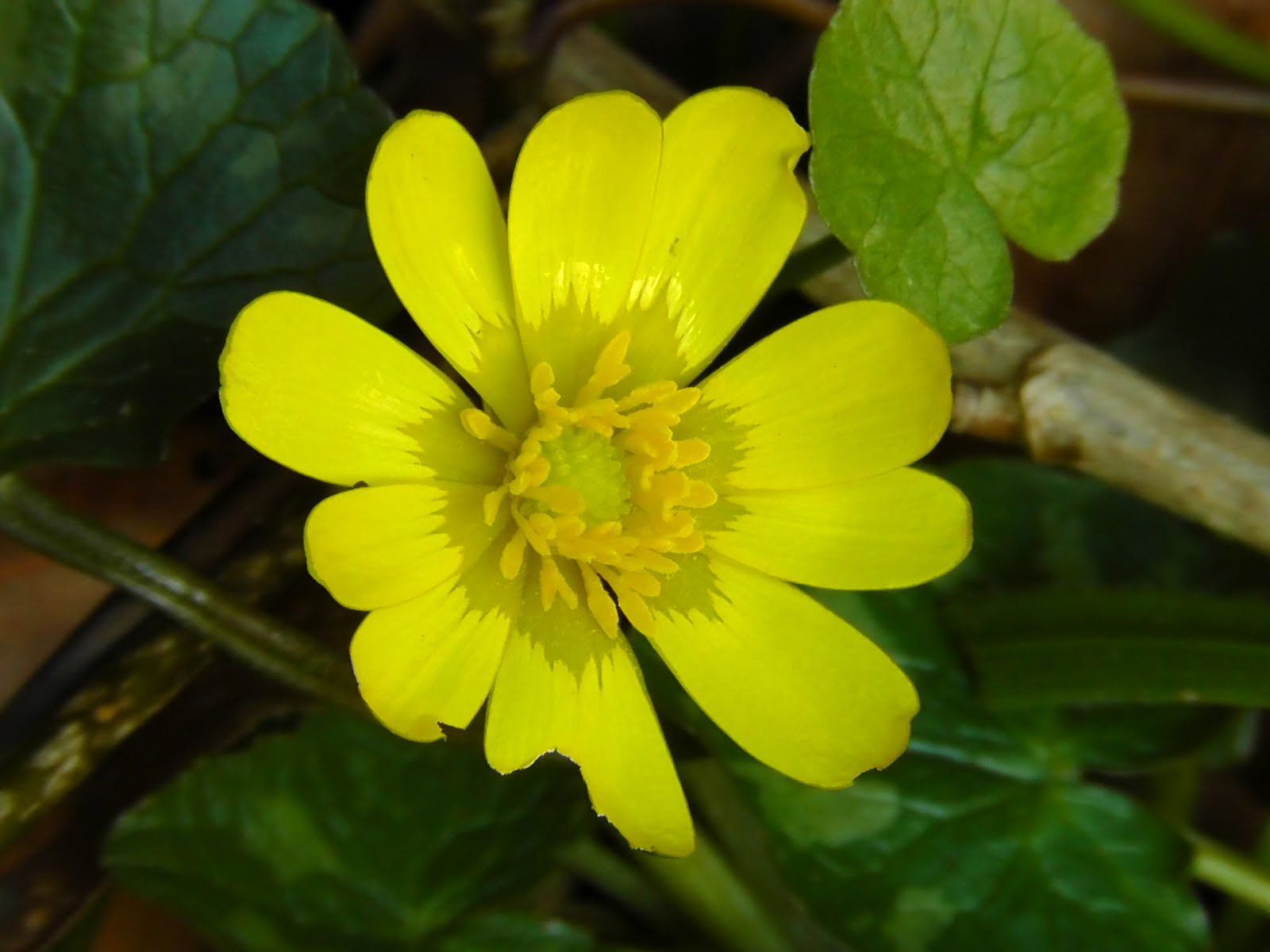
Spring is on the way….and I can’t wait!! The Lesser Celandine is our prettiest buttercup and this was one of several which were adding a dash of bright colour to the scrub at the side of our local Longhalves footpath. Time to burst into a bit of Wordsworth methinks (it was his favourite flower, after all!):

“There is a Flower, the Lesser Celandine,
That shrinks, like many more, from cold and rain;
And, at the first moment that the sun may shine,
Bright as the sun itself, ‘tis out again!”


Let’s hope it’s going to be out a lot this year!


This video is filmed from the Freshwater Causeway end of the Western Yar River. The distant Greenshank stood out from among the other waders as it picked its way up the channel. It’s been loitering around over the Winter period.

Monday, February 13, 2012


Here on the Isle of Wight we are very fortunate in having a healthy population of Red Squirrels, the English Channel forming a handy barrier to prevent the incursion of the alien Grey Squirrel. I'm told that the occasional Grey Squirrel makes the leap, courtesy of a Wightlink or Red Funnel ferry, but they are soon dealt with. And, if you did happen to try to smuggle one across and got caught, you'd face a 2 year imprisonment or £5000 fine!

The Red Squirrel above was spotted in Golden Hill Country Park, which bounds our quiet little estate on 2 sides. I didn't have much hope of seeing one in the road, though. But then, a few weeks ago I happened to be looking out of our front window when a Red Squirrel bounded across the lawn on the opposite side of the road. Wow! I ran out with the video canera and the result is below. I'm disappointed by the poor footage, considering how close I was to it, but I'm hoping for some good quality footage as the year goes on. Our house is the one you can see at the beginning of the video, just to the left of the blue car.

Wednesday, February 8, 2012

Tang Snipes in Colwell Bay!


Shetlanders call it the Tang Snipe or Plover’s Page, but we know it simply as the Dunlin – the archetypal small wader whose relatively small British population is supplemented by the continental crowds to give us a winter population of some half a million individuals!

The video above shows a small flock present on the rocks in Colwell Bay at low tide a few days ago. It never ceases to amaze me how close you can approach various bird species here on the island. I’m used to seeing a distant speck through a telescope, but this flock quite happily went about their business whilst I stood quietly watching them just 10m or so away!

This winter plumage is not exciting, but soon the new reddish upperparts will begin to appear, together with a dramatic large splash of black on the breast and belly. The change is so dramatic that, in the past, it was believed that there were 2 species, the ‘summer dunlin’ and ‘winter dunlin’.

So why the strange name ‘Plover’s Page’? Because of the strange habit Dunlin have of following Golden Plover around and sticking close. Why? It’s reckoned that it’s a good way of being warned by the Golden Plover of predators on the prowl.

I love the sewing-machine-action of feeding Dunlin. In the video below you can watch one individual hunting amongst the rocks for small molluscs, worms and crustaceans.

Saturday, February 4, 2012

Freshwater Bay

Carole and I went for an invigorating walk along the cliffs above Freshwater Bay this morning.

This is a new discovery for me….a Common Whelk egg mass with developing Common Whelks inside! Normally I’m only by the seashore whilst on holiday in the middle of summer and so only find the empty cases, looking like a lump of popped bubble wrap!

January is breeding time as far as the Common Whelk is concerned so it will only have been a matter of days or, maybe weeks, since this mass was anchored to a piece of rock below sea level. But this mass has come loose before time, and I found it washed up on the tideline at Freshwater Bay.

Living with the sea on 3 sides is giving me the opportunity to learn lots of amazing new facts. One of my text books says that each capsule, or cell, within the egg mass contains about 12 fertile and a thousand ‘nurse’ eggs. By eating the nurses the newly hatched whelks grow that much larger and stronger before emerging through the capsule exit to the outside world. Suddenly, these ‘bath sponge’ cases are even more fascinating!

It’s amazing how much history you can learn by studying plants. There were the dessicated remains of Carline Thistles carpeting the cliff top. Apparently they are named after Carl the Great, aka the Emperor Charlemagne who supposedly staved off the plague from his stricken army after being shown how to use the healing properties of this plant by an angel!

Or maybe you’re more interested in its supposed aphrodisiac qualities….though, in order to benefit, you would need to plant it and then harvest the root during a new moon…and ‘fertilise’ it with the sperm of a black stallion! Hmmm….maybe not, then!

Wednesday, January 4, 2012

Back to Beds!

We were back in Bedfordshire to celebrate New Year and so I took the opportunity on a mild New Year’s Day to get out and about, my main priority being to catch up with some deer. The Isle of Wight has a wealth of wildlife, but wild deer are conspicuous by their absence, though the odd Fallow Deer is reckoned by some to swim across the Solent and visit from time to time.
I caught up with a pair of fleeing Muntjac and another distant male Muntjac at Kingshoe Plantation, but the best sighting of the day was a group of 8 Chinese Water Deer in a field alongside Flying Horse Farm, just east of Ridgemont. The video’s not great, but it does vividly illustrate the amount of hormones there are around at this time of year!

With just under an hour to spare before meeting up with the family for dinner, I decided to try one of my favourite spots for Brown Hare. Unfortunately, I drew a blank, but did come across this slime mould, which I think is Mucilago crustacea, delightfully referred to in some places as Dog Sick/Vomit Slime Mould! Slime moulds are fascinating things. This is what the Royal Horticultural Society says about them:

‘Slime moulds do not attack plants, but obtain their food by engulfing bacteria, fungal spores and other tiny pieces of organic material as they move. Some slime moulds spend most of their life as single-celled, amoeba-like structures, invisible to the naked eye. Others form a larger structure called a plasmodium. The plasmodium constantly changes its shape as it creeps along, and is sometimes seen as a white or yellow (but sometimes other colours) slimy ‘sheet’, or a network of strands, on the soil, grass or stems and lower branches of plants.

Slime moulds are triggered into spore production by environmental conditions. Depletion of nutrients is a common trigger. The spore-producing structures may develop throughout the year, but are found most commonly in late summer and autumn. The spores of many slime moulds are extremely resilient and can survive for many years before germinating.’

Friday, December 2, 2011

Golden Hill Country Park

I came across this confiding Great-spotted Woodpecker at Golden Hill Country Park, Freshwater, this morning. You can see how well adapted he is for the job (the red patch behind the head indicates that this is a male). The two-forrard and two-aft facing toes give a great grip, even upside down, whilst the stiff tail steadies the ship! And that beak can do a lot of damage. Then there’s the tongue…I did read somewhere that it is an amazing 14cm long, its sticky saliva and bristles preventing any grubs or other invertebrates from escaping. In fact, you’ve got to feel a wee bit sorry for any grubs this individual comes across. After all, it’s a pretty mean machine!