
Saturday, February 25, 2012
Water Vole!!!


Friday, February 24, 2012
Red Squirrel Day!
I was really pleased to come across these three Red Squirrels earlier today as, so far, I've only seen singles at any one time. These 3 were in a wooded area just off the old railway path running along the side of the Western Yar estuary.
 There was a drey there, too, so I think I've found the ideal place to follow the fortunes of a family of Red Squirrels over the year. I was trying to work out how I might identify them, but then noticed that the first squirrel in the video has some sort of abnormality on the top of its head, so I've decided to call it 'Scratch'!!
 This one looked so delicate & petite that I decided it must be a female. Her pelage was also a rich red colour, so 'Red' it is!
 And the last of the bunch was much greyer...'Dusty' it is!


Thursday, February 23, 2012
Encouragements & Discouragements
After getting up soon after 4am this morning to get some work done I reckoned I'd earned myself a bit of sunshine. There were various articles I needed to read so I surmised that I might as well read them in the fresh air! The discouragement was the failure of any Water Voles to appear over 4 hours silently waiting at Afton Marsh. Hopefully they will become a bit less nocturnal and a lot more visible over the next few months. There are still plenty of signs, including this well-used latrine on an alder tree root...
 And this is the encouragement - a Spotted Redshank that was present at Mill Copse Pool. I'd heard that it was around so it was good to catch up with it....

Wednesday, February 22, 2012
Toilet Talk (1)
Well, it’s a cold, wet & dreary afternoon even on the Isle of Wight. I’ve wimped out of going for a walk in favour of doing some work in the comfort of the front room. The Badger’s hoovered up the peanuts in the back garden the last few evenings, but arrives well after our bedtime so I’ve not got any video footage yet. The sows should be giving birth to the cubs about now, so I’m already hoping for a family visit later in the year!
 Recently, I was wondering why I hadn’t come across any Badger latrines in the area. Badgers defecate into holes that they have dug in immediate area of the sett and, also, generally within the territory of the social group (‘hinterland latrines’). But they also set out ‘boundary latrines’ along the edge of their territory. Last week I came across some latrines at the top of the footpath in the corner of our estate just on the left-hand side of the other side of the arch in the photo.
 I think that it’s probably a boundary latrine. Badgers tend to use half of their boundary latrines over a period of days before swapping to the other half. It’s mainly the males that use the boundary latrines and their main purpose is for clearly marking out the territory of the group, though they seem to communicate so much more.
 In the New Naturalist Book, Badger, Timothy Roper makes the following observations:
‘The classical view is that the boundary marks, not just in badgers but more generally, constitute ‘keep out’ signals, posted to deter intruders from entering the territory. However, this idea is almost certainly an oversimplification, for a number of reasons. First, it fails to do justice to the wealth of olfactory information that is being deposited or to explain why, if the message is so simple, badgers spend so much time sniffing at the contents of latrines. Second, it fails to explain why badgers do, in fact, invade one another’s territories on a regular basis for foraging, mating and scent-marking purposes, often without meeting any resistance on the part of residents. Third, it is hard to see why, in principle, a ‘keep out’ notice, in and of itself, should act as a deterrent. And finally, the ‘keep out’ hypothesis fails to acknowledge what is perhaps the most striking feature of boundary latrines: namely, that when neighbouring groups share a common territory boundary, they also share the latrines along that boundary. This suggests that boundary latrines exist for the mutual sharing of information between neighbours, rather than for delivering a one-way threat from a resident group to would-be intruders.’


Tuesday, February 21, 2012
Spring birdsong - The Dunnock
The weather warmed up considerably this morning and it was obviously having an effect on the hormones of the local bird population who were singing with a spring in their step all over Golden Hill Country Park.
I went for a walk first thing and recorded this Dunnock singing. The light is not good, but I like the early morning silhouette. What I found interesting about this bird is the warble that can be heard at 49 seconds, 1 minute 07 seconds and 1 minute 14 seconds. I confess that I've never really noticed it before, unless this is a variation for this region or else this particular bird:
Dunnocks, or Hedge Accentors, can be heard singing all over the place. The best description I've heard of this song is that it reminds you of a squeaky trolley being pulled along. The call sounds like a rusty hinge on a gate - a simple 'creak'.
According to research, Dunnocks string together between 2 and 5 different phrases to make up a song sequence. They have a repertoire of some 10 to 15 phrases which they mix and match. After singing a particular song the bird will then change the sequence. What is fascinating is that research shows that the male will typically change to a new song after he has sung the same sequence about 20 times. But, if he is actively searching for a mate, then he will change the song after only singing it a few times. It's all very complicated (just like the life of a Dunnock which I'll share another time) but if you want to learn more you can read a fascinating paper here.
This year I'm going to be listening particularly closely to just what our local accentors are singing! And listen out for that little warble and let me know if you hear it where you live!
Monday, February 20, 2012
Success!! Encouraging Foxes & Badgers into the back garden (Part 2).
I've been really encouraged by the initial results of my efforts to try to encourage our local Foxes and Badgers into the back garden (see below).
This morning my sand tray looked like this:
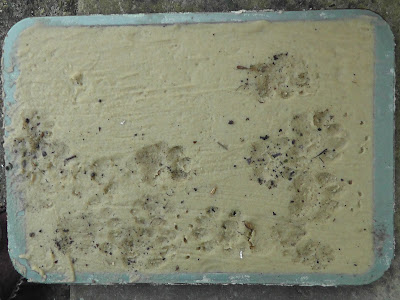 There is a nice pair of front Badger feet, together with what looks like the prints of one of the small local cats.
 These are the front feet - the distance of the claw tips in front of the toe pads gives an idea of just how long the claws are!
 These are the prints of a Red Fox that visited the garden the first evening I tried this. The sand was too dry to make a good impression, so I dampened it to get the better results for the badger.
 Last night's sharp frost has meant that it is fairly easy to see how the Badger has wandered around the garden in its heavy-footed plantigrade way.
 This is one of the reasons why most people don't like to encourage Badgers into their gardens!! I've repaired the damage here and in a few other places....hopefully any further damage will remain at this low level for a while.
The next stage is to attempt to get a photo or bit of video of our nocturnal visitors!


Friday, February 17, 2012
Encouraging Foxes & Badgers into the back garden (Part 1)
 This is our home. We’re very fortunate in getting larger mammals passing by at night but I’d like to get even better views by trying to entice them into the back garden where the security light on the shed should make them easier to see and, lacking passing cars & late-night dog walkers, they should learn to feel a bit more settled.
 This is the corner of the fence that you can see right next to the house. There was already a small gap, but I’ve widened it to make it a bit easier to access the back.
 This is the gap looking from the other side. You’ll notice that I’ve laid a trail of peanuts to entice any passing animals to enter and then loiter in the back garden! The white thing is a baking tray filled with soft sand (children’s sand from Argos) which will hopefully record the prints of anything that arrives.
 I’ve deliberately tried to encourage any visiting mammals to follow the line of the house and enter the back garden proper via the gap between the shed and the house.
 There are peanuts sprinkled over the lawn and some water placed in an old plastic pork chop tray beneath the bird table!
Here's hoping……Watch this space!
Subscribe to:
Posts (Atom)